

Metal components used in dentistry, aerospace, tooling, and industrial equipment require different levels of strength, corrosion resistance, and heat resistance. Selective laser melting (SLM) enables complex geometries but requires careful control of alloy-specific parameters and powder handling.
Manufacturers must ensure that equipment and validated processes consistently meet component specifications. Understanding alloy properties and material changeovers supports informed production decisions. Selecting a laser 3D printer requires validation for the intended alloy and component.
Why Different Alloys Need Different Printing Parameters
An SLM system spreads a thin layer of metal powder across a build platform and selectively melts it with a laser. The process repeats layer by layer until the component is complete. Although the basic mechanism remains similar across materials, different alloys respond differently to the laser and the surrounding thermal conditions.
Melting behavior, thermal conductivity, reflectivity, and solidification characteristics influence how an alloy absorbs energy and cools. These differences can affect porosity, cracking, distortion, residual stress, and surface quality. A parameter set developed for one alloy may therefore produce poor results when applied to another.
Laser power is only one variable. Scanning speed, hatch spacing, layer thickness, and scanning strategy can also affect the quality of the finished component. These settings must be considered together and validated for the material, geometry, and intended application.
Powder properties matter as well. Particle-size distribution and flowability influence how evenly the powder spreads across the build platform. Moisture, oxidation, or contamination can introduce additional problems. Manufacturers should therefore evaluate both the material specification and the machine’s ability to maintain a suitable, repeatable processing environment.
Match Alloy Selection to Application Requirements
Stainless steel offers strength and corrosion resistance, while titanium alloys provide a high strength-to-weight ratio for aerospace and medical applications. Cobalt-chromium alloys are used in dental components, and nickel-based superalloys are suitable for high-temperature environments.
These examples illustrate broader metal additive manufacturing applications. Material selection should still be based on the specific alloy grade, operating environment, mechanical requirements, and applicable industry standards.
For OEMs and industrial buyers, this means defining the required material before selecting equipment. A broad claim that a machine processes stainless steel or titanium does not necessarily establish that every grade within that family is suitable. Buyers should confirm the specific alloy and ask what process information or technical assistance is available for their intended application.
Control Powder Changeovers and Cross-Contamination
In conventional single-material SLM production, a build normally uses one selected alloy powder. Different alloys should not be mixed casually within the same powder supply. Uncontrolled mixing can change the material composition and affect the properties of the resulting parts.
When changing materials, manufacturers need a documented changeover procedure. This may involve removing residual powder, cleaning powder-contact components, and inspecting the build chamber.
The required cleaning steps depend on the machine and material. Manufacturers should confirm the procedure with the equipment supplier, especially when material purity is critical.
Powder recovery also requires control. Unused powder should not automatically be treated as equivalent to fresh powder or returned to another material batch. Reuse should follow the powder supplier’s recommendations and the facility’s qualified procedures. Clear labeling and batch records help operators distinguish materials and maintain traceability between builds.
Fine metal powders can pose inhalation, skin-exposure, fire, and explosion risks. Operators should follow equipment instructions, safety data sheets, and facility procedures. NIOSH provides guidance on managing metal powder hazards.
For facilities processing several alloys, production scheduling can reduce unnecessary changeovers. Grouping compatible jobs by material may simplify preparation and cleaning. However, the schedule must also account for customer deadlines and urgent production requirements.
What to Confirm Before Choosing a Metal 3D Printer Machine
A metal 3D printer machine should be evaluated against the actual alloys, part dimensions, and production requirements of the business. Before purchasing equipment, buyers should confirm the supported alloy grades, available process parameters, powder recovery arrangements, and procedures for cleaning between materials.
They should also ask what technical support is available for parameter development and process validation. For specialized components, a successful demonstration with one material or geometry does not automatically establish suitability for a different application. Representative part files and clearly defined acceptance criteria can help make equipment evaluations more meaningful.
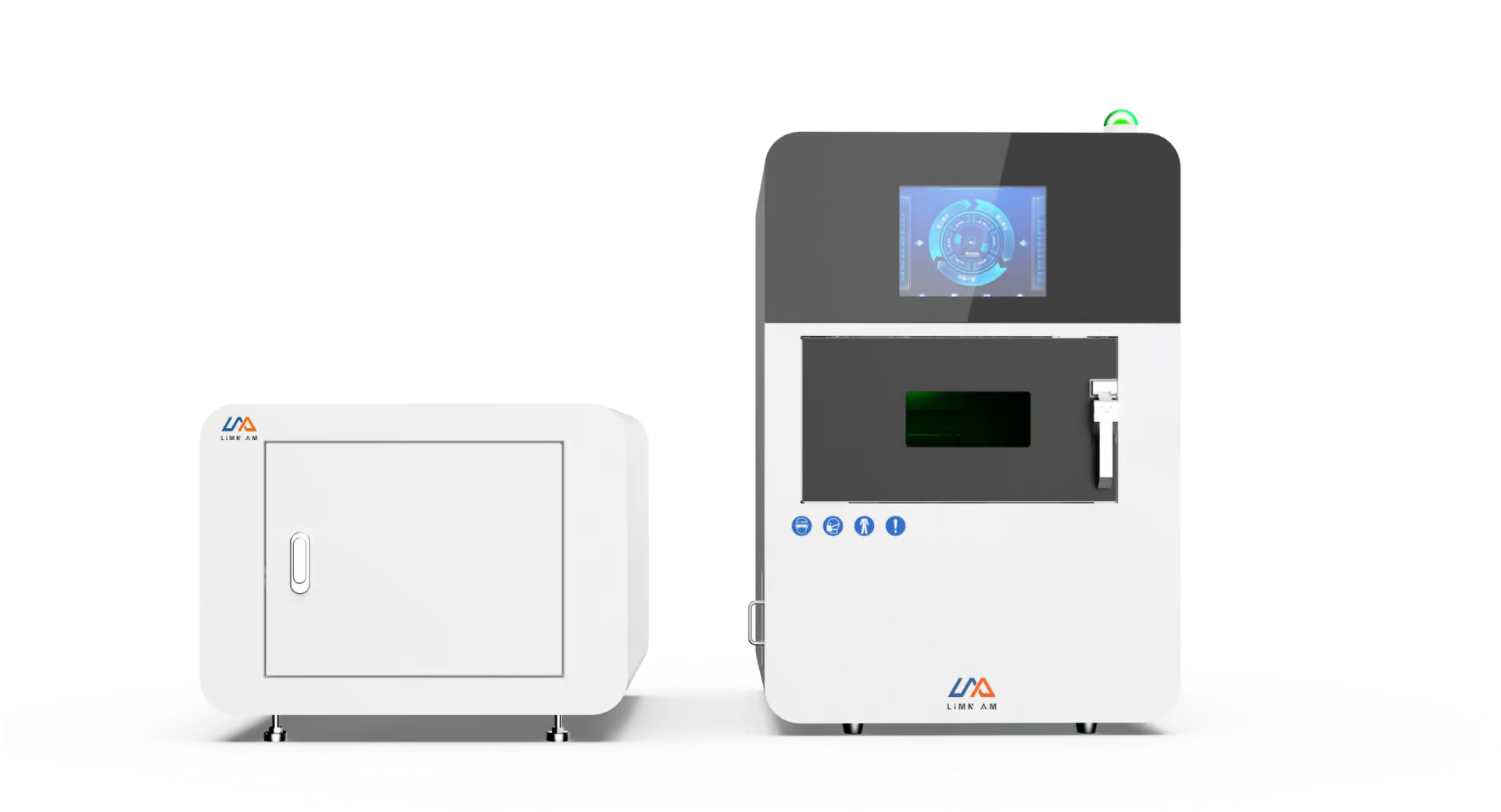
LiMN 3D’s LM-M100D Lite is a compact SLM system positioned for small metal components, including dental applications. Its specification table lists a 300 W light source and a powder layer thickness of 20–60 μm. The product information identifies titanium alloys, cobalt-chromium alloys, and stainless steel among its compatible materials.
Buyers should confirm the quoted configuration and supported alloy grades for their application. The general application examples in this article do not establish LM-M100D Lite compatibility with every alloy mentioned. The listed layer thickness is a process setting, not a guarantee of dimensional accuracy.
Validate the Process Before Production
LiMN 3D provides metal additive manufacturing equipment and technical support for industrial applications. OEMs and manufacturers can contact LiMN 3D to discuss alloy requirements and suitable printing solutions.
Reliable alloy processing starts with validated parameters and controlled powder changeovers.
