

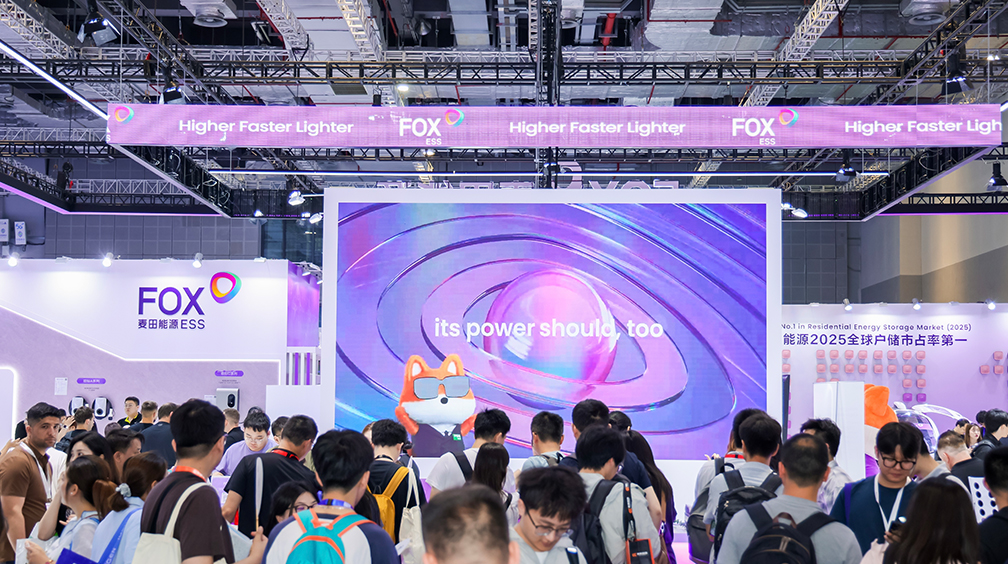
Residential storage leadership is difficult to sustain through product performance alone. It requires market acceptance, independently demonstrated efficiency, continuous engineering investment, a coherent product ecosystem, and the ability to deliver support across multiple markets.
Recent evidence places Fox ESS strongly across these dimensions. S&P Global Energy ranked the company No. 1 globally for residential energy storage based on 2025 MWh shipments, while HTW Berlin and AQUU Research separately assessed a Fox ESS storage configuration with a 97% System Performance Index (SPI).
Together, those results point to a combination of commercial scale and technical performance rather than a single source of competitive strength.
Market Position Provides the First Proof Point
Market share is one of the clearest external indicators of whether residential energy storage products are being adopted at scale. According to S&P Global Energy’s Residential Energy Storage Market Tracker, Fox ESS ranked No. 1 worldwide in 2025 by MWh shipments. The same assessment placed the company first in Germany and the UK, two important residential storage markets.
A separate 2026 white paper jointly released by Fox ESS and Frost & Sullivan reported that the global residential energy storage system market reached 38.1 GWh in 2025 and placed the company first by shipment volume, with a reported 10.5% global market share.
Such results matter because market leadership reflects more than visibility. Significant shipment volumes require products that distributors can sell, installers can deploy, and homeowners are willing to adopt. That makes market scale an important foundation for evaluating the company’s energy storage solutions.
Independent Testing Adds Technical Credibility
Commercial success alone does not establish technical leadership. Independent testing provides a different form of evidence, particularly for installers comparing storage systems that may look similar in a datasheet.
HTW Berlin and AQUU Research evaluated 12 storage systems in the cited assessment, with eight assessed in the 10 kW category. A Fox ESS configuration combining the PQ-H3-Ultra-10.0 inverter and EQ3300-5 battery achieved a 97% SPI and an Efficiency Class A ranking.
SPI is a system-level measure, so the result should not be confused with the efficiency rating of an individual component. Its value lies in showing how the defined storage configuration performed under an independent assessment. For potential customers, that makes independently tested performance a useful complement to manufacturer specifications.
R&D Turns Market Scale Into Product Development
A large installed base can provide valuable market feedback, but sustained leadership depends on turning that experience into engineering improvements. Fox ESS reports more than 400 R&D specialists and 5 R&D centers globally in its corporate and residential-storage materials.. Its current corporate information also lists more than 5,000 employees and operations in more than 90 countries.
Recent product development illustrates how that investment is being translated into hardware. The PQ3-Ultra, introduced in 2026, uses Infineon SiC technologies and engineering optimization. Fox ESS reports a 70% reduction in switching losses, alongside 98.78% PV grid-tied efficiency and 98.47% battery charge/discharge efficiency for the specified product.
These figures apply to the stated product and conditions, but they demonstrate the direction of development: improving conversion performance while simplifying residential energy infrastructure.
An Ecosystem Extends Beyond the Battery
Modern residential storage is increasingly becoming an energy-management platform rather than a standalone battery. Fox ESS offers an integrated portfolio covering hybrid inverters, batteries, EV chargers, heat pumps, and microinverters, allowing residential projects to combine several energy technologies within one broader ecosystem.
That breadth supports a more complete approach to sustainable energy storage. Homeowners can consider generation, storage, charging, heating, and energy management as connected elements rather than unrelated purchases.
Digital control adds another layer. FoxCloud 2.0 provides smart energy monitoring and management, allowing users to track production and consumption, control energy use, and optimize system performance through AI-powered functions. A 2026 Fox ESS white paper on the residential energy storage market also highlights AI-driven algorithms, remote monitoring, predictive maintenance, and optimized dispatch as important developments in the sector.
For installers, an ecosystem can also simplify supplier relationships and system integration. For homeowners, it creates a clearer path toward managing more household energy through a connected platform.
Global Execution Makes the Technology Deployable
Technology only becomes commercially valuable when it can be installed and supported reliably. Fox ESS has expanded its international footprint with offices and service teams in markets including Germany, the UK, Italy, Poland, and Australia. The company also reports operations across more than 90 countries.
Local execution is particularly relevant to residential storage because installers need technical support, training, product availability, and region-specific expertise. Fox ESS has also developed an installer program that began in Germany and is being expanded region by region.
That combination of global scale and local delivery strengthens the commercial proposition. A technically capable product becomes easier to specify when the surrounding distribution and service infrastructure can support deployment.
Leadership Is Built Across the Entire Residential Energy Chain
The evidence suggests that Fox ESS’s position is supported by several reinforcing factors rather than one headline achievement. No. 1 global shipment rankings demonstrate market acceptance, while the 97% HTW Berlin SPI result provides independent evidence of strong system performance. R&D investment and new product development add an innovation dimension, while the wider ecosystem connects storage with other household energy technologies.
For installers and distributors, that combination can make Fox ESS a compelling partner when evaluating long-term energy storage solutions. For homeowners, the broader proposition extends beyond storing electricity: it encompasses connected energy generation, management, charging, and heating.
The strongest case for Fox ESS leadership therefore comes from the alignment of scale, engineering, independent performance evidence, product breadth, and global execution.
Those elements collectively support the company’s ability to deliver sustainable energy storage as part of a complete residential energy strategy rather than as an isolated battery product.
