

Modern dental laboratories face rising production demands that challenge traditional workflows. Delivering crowns, clear aligners, and surgical guides quickly requires maximizing throughput. High turnaround speeds must never compromise marginal fit or clinical precision.
Historically, accelerating printing cycles meant risking layer separation or surface defects. Technicians often balanced speed against dimensional accuracy to avoid remakes. Today, modern platforms like the Riton RXDent-L230 resolve this trade-off using optimized light engines.
Integrating fast curing cycles with robust motion control allows modern laboratories to scale production. High-volume output maintains micron-level tolerances required for restorative dentistry. Advanced additive platforms deliver both rapid manufacturing and exceptional detail reproduction.
Technical Features of an LCD Resin 3D Printer
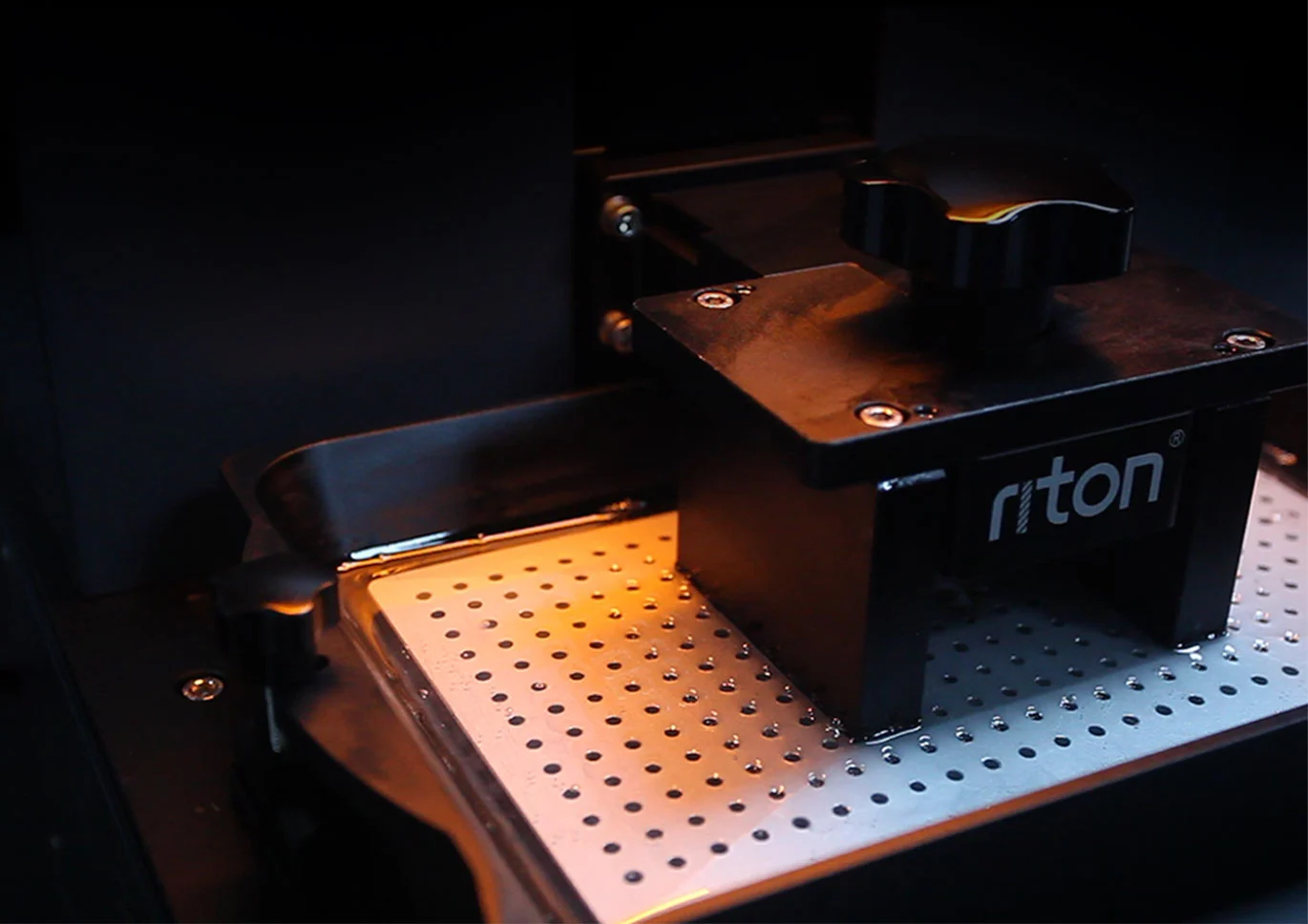
Masked stereolithography has transformed desktop additive production in dental environments. An advanced LCD resin 3D printer combines a UV LED light array with a high-resolution liquid crystal masking system to cure complete resin layers simultaneously, improving printing efficiency while maintaining consistent detail across the build area.
Simultaneous layer curing provides a major speed advantage over single-point laser scanners. Print duration depends solely on total model height rather than part quantity. Adding multiple arch models or die preps does not increase cycle time.
Uniform light distribution across the LCD mask prevents localized curing variances. Modern LCD resin 3D printers incorporate optimized optical systems to improve UV intensity uniformity across the build area, helping maintain consistent exposure conditions and more reliable polymerization from the center to the edges of the platform.
Modern panels feature monochrome screen technology to maximize UV light transmission. Higher light intensity accelerates photopolymer cross-linking, significantly shortening individual layer exposure times without sacrificing edge definition or dimensional accuracy.
Mechanical Stability in a High Speed Resin 3D Printer
Operating a high speed resin 3D printer requires balancing rapid light curing with stable mechanical motion. Fast vertical movement creates hydraulic drag in liquid resin tanks, which can distort delicate support structures or thin margin lines.
To counter these forces, high-speed platforms incorporate rigid Z-axis drive assemblies. Heavy-duty linear guide rails reduce mechanical wobble, maintaining precise layer alignment throughout accelerated lift cycles.
Optimized release films further enhance speed by reducing peeling forces during layer separations. Lower separation forces allow faster Z-axis retraction without damaging fragile green-state prints, enabling shorter total cycle times during high-volume production runs.
Advanced software control coordinates light exposure timing with mechanical motor acceleration. Intelligent motion algorithms adjust lift speeds based on part geometry, ensuring maximum velocity during solid sections while protecting delicate margin boundaries.
Precision Engineering and Optical Fidelity
High manufacturing velocity must remain grounded in optical fidelity. The Riton RXDent-L230 combines high-printing-speed layer exposures of 1 to 8 seconds with an 8K monochrome display, featuring a 7680 × 4320 resolution and 30μm accuracy.
This microscopic pixel grid ensures crisp reproduction of complex margin lines and internal crown surfaces during rapid runs. Technicians produce fine anatomical detail without sacrificing the throughput speed necessary for tight delivery schedules.
A generous 228 × 128 × 150 mm printing range allows high-capacity batching. Laboratories can print more full-arch models or die preps simultaneously, maximizing daily unit output on a compact machine footprint.
Variable layer thickness settings between 0.01 and 0.2 mm offer operational flexibility. Technicians easily balance maximum production speed against surface finish requirements, tailoring exposure parameters for master aligner models or rapid draft preps.
Operational Advantages for Dental Laboratories
Deploying a high speed resin 3D printer transforms daily laboratory schedules and order fulfillment. Rapid turnaround times allow facilities to process same-day clear aligner orders or emergency crown preps without disrupting scheduled production.
Increased speed directly improves equipment utilization rates and return on investment. Laboratories produce higher daily unit volumes on a single machine, reducing the need to purchase multiple slow-speed units to satisfy growing client demand.
Material flexibility remains high across accelerated curing profiles. Specialized photopolymers—including model materials, castable resins, and biocompatible formulas for implant guides—cure with consistent dimensional accuracy and structural integrity.
Integrated RTware slicing software further optimizes throughput. Automated support generation and calibrated exposure profiles streamline pre-processing, preventing file translation errors and minimizing resin consumption during complex high-speed printing runs.
Enterprise Infrastructure and Global Support
Sustained production speed depends on equipment reliability and dedicated technical service. Riton brings decades of expertise in laser and additive engineering, providing end-to-end support for facilities transitioning to high-speed digital workflows.
Pre-sales guidance helps facilities assess daily production capacity and workflow integration. Experienced application engineers configure optimal software parameters and material profiles to ensure new hardware operates at peak efficiency from day one.
Post-sales technical support provides direct access to skilled service personnel. Routine firmware updates, remote diagnostics, and preventative maintenance protocols safeguard hardware longevity and maintain tight optical calibration over years of heavy commercial use.
A global distributor network delivers localized service and prompt spare parts distribution. Local technical teams assist with operator training and physical maintenance, minimizing operational disruptions and protecting long-term capital investments.
Strategic Growth Through Faster Additive Manufacturing
Adopting high-speed additive technology represents a strategic upgrade for growing dental operations. Combining rapid light exposure, rigid mechanical drives, and high optical resolution ensures reliable manufacturing at high speeds.
Utilizing a high-performance LCD resin 3D printer enables laboratories to meet tight delivery windows with total confidence. Micron-level accuracy ensures physical output matches original CAD files without requiring costly chairside adjustments.
Through advanced optical design and robust global service, Riton empowers dental facilities to scale production efficiently. High-speed resin printing establishes a dependable foundation for continuous business growth and clinical excellence.
