

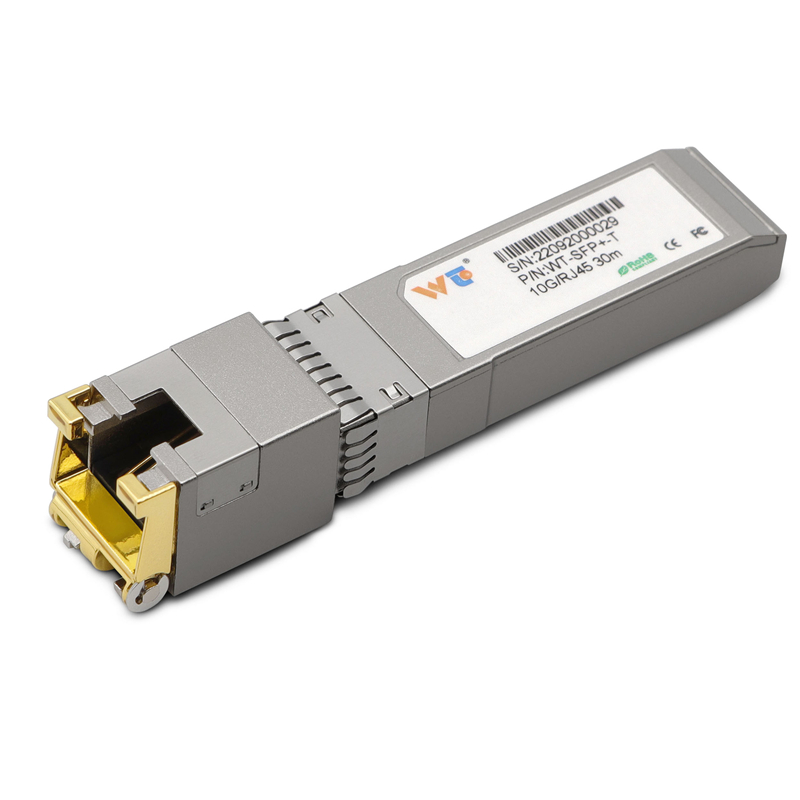
Network infrastructure rarely changes all at once. A server room may receive faster switches while printers, workstations, controllers, and existing cable runs remain in place. 10G SFP to RJ45 connectivity helps bridge this gap by allowing a compatible SFP+ port to communicate over twisted-pair Ethernet, giving network teams another way to upgrade bandwidth without converting every connection to fiber.
The practical value depends on interface support, cable conditions, power demands, and the role of each link within the wider network. Evaluating these factors should begin with verifying the host switch’s power and thermal limits, as copper modules typically consume more energy than optical alternatives. By deploying copper modules for specific links, network teams can achieve phased bandwidth upgrades without committing to a full-scale fiber replacement.
Why Copper Connectivity Still Matters in High-Speed Networks
Fiber is well suited to high bandwidth and longer-distance connections, yet copper remains common in equipment rooms and enterprise access networks. Many endpoints already use RJ45 ports, and retaining suitable cabling can reduce disruption during staged infrastructure upgrades.
Copper connections also simplify integration when devices are located within the supported Ethernet channel distance. Instead of replacing every cable run, network planners can assess which links genuinely need optical transmission and which can continue using twisted-pair wiring.
The key is to treat copper and fiber as complementary options rather than competing technologies. Fiber may suit backbone links or electrically noisy environments, while copper can serve nearby equipment where existing infrastructure and installation requirements make it practical.
How SFP+ Converts a Port Into a Copper Ethernet Link
An SFP+ cage provides the physical interface for a compatible transceiver, but the installed module determines how the signal reaches the connected network. A copper transceiver translates between the host switch’s electrical interface and the signaling required for Ethernet communication over twisted-pair cable.
With 10G SFP to RJ45, the RJ45 connector provides a familiar termination for copper Ethernet wiring, while the SFP+ side fits into a supported switch port. This arrangement can connect a switch with SFP+ interfaces to a copper-based device without requiring a separate media-conversion appliance. This direct conversion supports mixed copper-and-fiber environments, allowing administrators to reuse existing twisted-pair infrastructure without replacing the switch hardware.
Compatibility still needs careful verification. The switch must support the module’s operating rate, power requirements, and implementation; firmware restrictions or vendor-specific compatibility lists may affect whether a link comes online reliably. Matching the connector alone is not enough.
Cable Quality and Distance Shape Real-World Performance
The Ethernet standard and cable category determine how far a copper link can run at its intended data rate. Different Ethernet standards and cable categories support different combinations of data rate and link distance. Higher-grade cables generally accommodate faster speeds over longer runs, while lower-grade categories may only handle higher throughput at shorter distances, depending on installation conditions.
Cable performance can deteriorate because of poor terminations, damaged conductors, excessive patch connections, or electromagnetic interference. These issues may cause link instability or errors even if the cable appears intact, so existing infrastructure should be tested before it is assigned a higher-speed role.
Network teams should also distinguish the module’s rated reach from the performance of the entire channel. A 10G SFP to RJ45 transceiver does not extend the cable’s capabilities beyond the applicable Ethernet standard, and its own datasheet may specify additional operating limits that need to be observed.
Managing Heat, Power, and Link Negotiation
Copper transceivers perform substantial signal processing to transmit data across twisted-pair cabling. In many implementations, 10GBASE-T modules consume more power and produce more heat than lower-power optical alternatives, making port density and airflow important considerations in compact switches. Without adequate thermal design, the cumulative heat from multiple active ports can degrade switch reliability and performance.
A switch with several adjacent copper modules may experience greater thermal loading than one fitted with low-power modules. Before deployment, administrators should check the host device’s supported power budget, temperature limits, ventilation requirements, and guidance on simultaneous transceiver use.
Auto-negotiation can simplify link establishment by allowing compatible Ethernet interfaces to agree on an available operating mode. WINTOP’s supplied SFP copper transceiver information describes 1000BASE-T and 10GBASE-T SFP+ variants with MSA compliance. Exact cable reach, power consumption, and host support should be confirmed against the specification for the intended module.
Conclusion
A successful copper upgrade involves more than increasing the nominal link speed. Cable certification, channel length, host compatibility, heat dissipation, and the requirements of connected devices all influence whether a high-speed connection will operate as intended. Reviewing these factors before installation can reduce troubleshooting and help preserve the value of existing infrastructure.
With experience in optical networking equipment, WINTOP offers transceiver solutions for network environments that combine fiber interfaces with copper Ethernet connections. Network professionals can consult the official WINTOP website to compare available specifications and assess whether a compatible module fits their switch and cabling requirements.
