

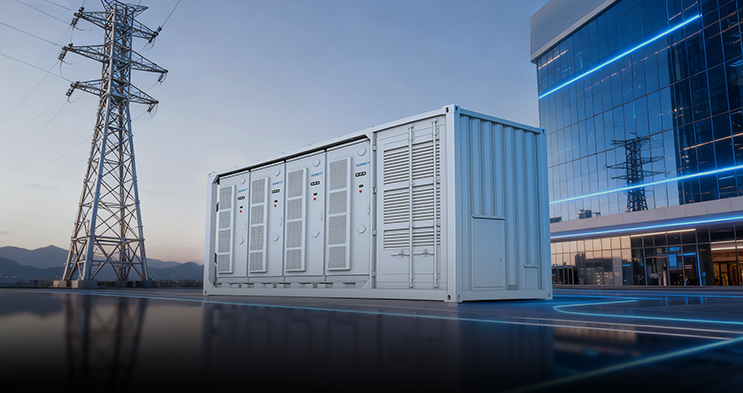
Integrating photovoltaic generation, battery storage, and an existing electrical network requires careful coordination of energy flows. Different connection architectures create different conversion requirements, operating limits, and installation costs.
An all-in-one energy storage system combines major components within an engineered package, reducing some onsite assembly requirements. However, integrated equipment does not automatically support every hybrid inverter function.
Choosing suitable all-in-one hybrid energy storage systems requires verifying the actual connection architecture and operating capabilities rather than relying on the product category name.
How Do Hybrid Storage Architectures Work?
A hybrid installation coordinates electricity from multiple sources, including solar generation, batteries, and the utility grid. Its electrical design determines the required power conversion equipment and how energy moves between the connected resources.
Understand AC and DC Coupling
In an AC-coupled design, photovoltaic generation and battery storage connect through suitable conversion equipment to a common AC network.
The photovoltaic inverter converts solar DC electricity into AC power, while the battery converter manages charging and discharging. DC coupling uses compatible DC-side equipment before conversion to the receiving AC network.
Neither arrangement is universally preferable.
A facility with an existing solar installation can have different requirements from a new solar-plus-storage project. Conversion losses, installed equipment, protection, and available connection capacity influence the design.
Distinguish Integration From Hybrid Functions
An all-in-one configuration groups major components, such as batteries, converters, cooling, and controls, within a coordinated enclosure.
Hybrid functionality concerns how electricity from different sources is integrated and managed. These characteristics can coexist, but they are required to be verified separately.
For example, a containerized battery equipped with a PCS does not automatically support direct photovoltaic DC connection.
Engineers must confirm the supported input arrangements, electrical interfaces, and operating modes. Assuming that every integrated storage product offers identical hybrid functions can lead to incorrect procurement decisions.
How Should Power and Capacity Be Selected?
Battery energy capacity and conversion power determine the basic operating capabilities of a storage installation. Both values should correspond to the site’s electricity demand and intended discharge duration.
Match Storage to Measured Demand
A facility requiring 500kW of discharge for two hours needs approximately 1,000kWh of delivered electricity before considering losses and usable energy restrictions.
A different installation can require higher power for a much shorter peak period. These applications demand different configurations even when total daily energy consumption is similar.
Engineers examine interval meter readings, production schedules, photovoltaic generation, and electricity tariffs.
Connection limits also matter. A battery cannot overcome restrictions imposed by unsuitable transformers or limited grid import and export capacity.
Compare Available PowerMount Configurations
Dunext’s PowerMount 2MWh is an all-in-one containerized energy storage system for commercial and industrial applications, available in battery capacity configurations of 1,505.28 kWh, 2,007.04 kWh and 2,250.75 kWh, with rated outputs of 720 kW, 480/960 kW and 960 kW respectively.
These figures demonstrate why the product family name alone cannot represent every available model.
A technical assessment should establish:
- The exact battery capacity and output rating.
- Supported electrical connection arrangements.
- Grid voltage and external transformer requirements.
- Expansion and maintenance compatibility.
When evaluating all-in-one hybrid energy storage systems, engineers verify each selected configuration rather than assume every option includes the same features.
What Installation and Safety Factors Matter?
An integrated battery operates within a larger electrical installation. The connection architecture, protective design, and maintenance requirements influence long-term performance.
Electrical Protection and Environmental Conditions
PowerMount 2MWh uses a three-phase 400V rated output configuration. This can simplify connection to suitable low-voltage networks, although external transformer requirements depend on the receiving electrical system.
Its enclosure has an IP54 protection rating. This rating describes specified protection against dust and water ingress rather than suitability for every outdoor condition.
Engineers must separately assess flooding, corrosion, environmental temperature, electrical faults, and emergency access. Independent battery-cluster management supports localized monitoring and protective functions within the system.
Installation and Lifecycle Planning
Factory-prefabricated equipment reduces the amount of onsite assembly, but foundations, cabling, communications, and protection testing remain necessary.
Commissioning needs to verify charging, discharging, emergency responses, and control-system communication. Maintenance teams also need access to cooling systems, batteries, and electrical components.
Expansion planning should consider whether additional storage capacity or conversion equipment can be integrated without substantial changes to existing infrastructure.
Dunext’s PowerMount architecture provides integrated storage options, but the selected model should be checked against actual project conditions.
Selecting All-in-One Hybrid Storage Systems
Selecting an integrated hybrid storage arrangement requires evaluation of electrical architecture, battery capacity, output power, and verified equipment functions. Installation safety and maintenance requirements remain essential regardless of integration level.
Dunext offers PowerMount 2MWh configurations with different capacities and output ratings. Successful selection depends on matching those specifications to the facility’s real electrical requirements.
