

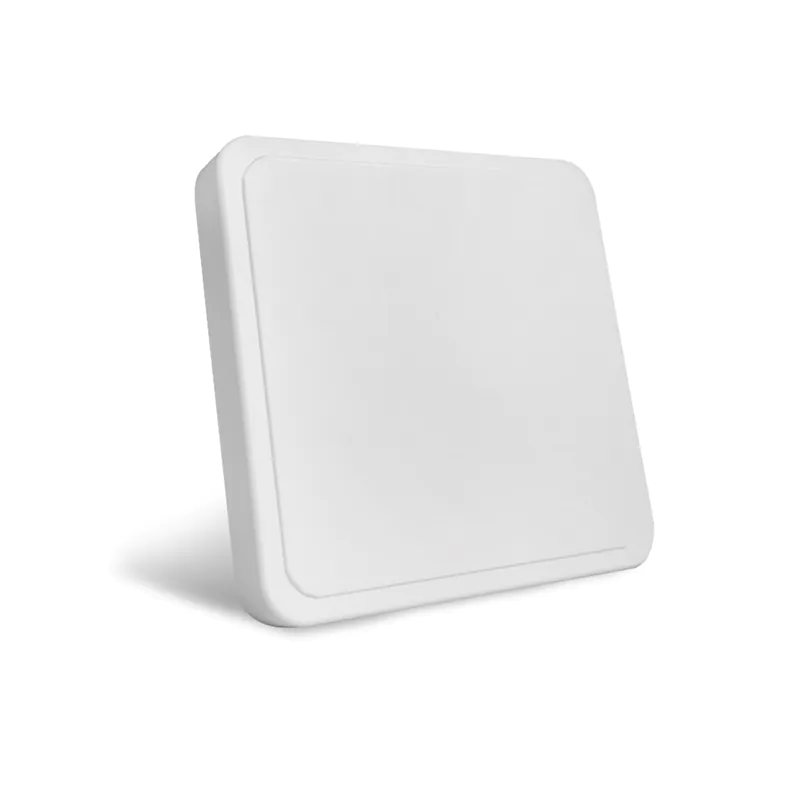
Metal-heavy industrial environments can make UHF RFID reads unpredictable because metal reflects radio-frequency energy, creating multiple signal paths, shadowed areas, and cancellation zones. A practical design must control where energy is concentrated, how the field interacts with surrounding structures, and how reliably the tag’s backscatter returns to the reader.
That makes antenna selection a system-design decision. A high gain RFID antenna can concentrate available RF energy into a more defined coverage area rather than spreading it broadly. Yet gain alone does not eliminate reflections or compensate for a poorly positioned tag. Radiation pattern, polarization, orientation, mounting position, and surrounding metal all influence the final result.
Why Metal Creates More Than Simple Signal Loss
Metal affects UHF RFID in two related ways. Conductive surfaces reflect electromagnetic waves. In a factory, warehouse, or production cell, steel racks, machine housings, conveyors, frames, and metal products can send reflected waves back into the reading zone. Direct and reflected waves may reinforce one another in some locations and cancel one another in others, producing dead spots and unexpected read areas.
Metal can also affect the tag itself. A conventional RFID tag placed directly on metal can become detuned, preventing its antenna from operating as intended. On-metal tag designs address this by separating or adapting the tag antenna to the metallic surface. Improving the reader antenna therefore cannot substitute for selecting a tag suited to the asset.
How Higher Gain Changes the RF Field
A high gain RFID antenna is useful when the objective is to direct more radiated energy toward a particular coverage area.
In a metal-dense area, tighter field control can reduce unnecessary illumination of adjacent structures or reading zones. That can be valuable beside parallel production lines, at defined conveyor points, or across a controlled portal. The objective is not simply maximum distance. It is sufficient field strength where the tag is expected while limiting unintended coverage elsewhere.
Polarization and Orientation Still Matter
Gain cannot overcome a mismatch between the antenna field and tag orientation. Linear polarization concentrates the field in one orientation and can provide greater read distance when the tag is aligned correctly. Circular polarization can be more tolerant when tag orientation changes, although the choice depends on the application and required coverage.
Metal structures make orientation significant because their surfaces can redirect RF energy. Installation should examine the radiation pattern at the intended read point instead of assuming nominal gain will produce the desired zone. RSTC’s RFID Antennas can be evaluated against the physical reading scenario rather than as isolated hardware.
Installation Determines Whether Gain Helps
Antenna placement can determine whether a system creates a controlled reading zone or unpredictable reflections. Mounting distance from large metal surfaces, antenna angle, tag travel direction, and neighboring antennas all affect the field.
Cable routing also matters because energy can be lost through the coaxial connection. Field testing should therefore measure actual tag response where assets will be identified rather than relying only on theoretical coverage.
Define the intended read zone before increasing RF power. Higher power may compensate for a weak area, but it can also extend the field into places where unwanted tags become readable. Controlled antenna direction and placement can be more useful than simply pushing power higher.
Where Focused Gain Provides the Most Value
High gain is particularly relevant where tags follow a known path and the system needs focused coverage, such as conveyor identification points, fixed workstations, storage lanes, or controlled portals. These scenarios give the integrator a physical target for shaping the RF field.
A different strategy may be needed when tagged assets approach from many angles or occupy a large three-dimensional area. A broader pattern or different polarization may then produce more consistent coverage. RSTC therefore treats RFID Antennas as part of read-zone design rather than assuming one geometry suits every environment.
A Practical Selection Sequence
Start by mapping the physical environment around the reader: machinery, racks, structural steel, conveyors, containers, and the tagged asset itself. Then identify the tag type and mounting surface. If a tag is attached directly to metal, an on-metal design may be necessary regardless of reader or antenna gain.
Next, define the required read zone. Establish where tags enter and exit the zone, how they move through it, their expected orientation, and where reads should stop. These requirements provide the basis for selecting antenna gain, beam width, and polarization.
The final step is validation under actual operating conditions. Test the complete reader, antenna, and tag configuration with representative machinery, tag orientations, nearby assets, and normal movement. The objective is not simply to maximize read distance, but to achieve consistent reads within the intended zone while minimizing unwanted reads outside it.
What Higher Gain Can—and Cannot—Solve
A higher-gain antenna concentrates RF energy into a narrower radiation pattern, which can increase usable coverage in a defined direction. However, higher gain does not automatically resolve problems caused by the RFID tag or its surroundings. Metal-induced multipath, tag detuning, polarization mismatch, poor positioning, cable losses, and uncontrolled reflections may still limit performance.
For this reason, antenna gain should be treated as a design parameter rather than a standalone performance solution. Reader power and settings, antenna geometry, mounting position, tag construction, orientation, and the surrounding environment all influence the final read performance. RSTC‘s antenna and reader hardware can therefore be considered as part of a broader RF design rather than as an isolated upgrade.
In metal-heavy environments, the practical objective is to establish a predictable read zone rather than simply maximize antenna gain. When antenna characteristics are matched to the tag, mounting surface, placement, and required coverage area, the RFID system can achieve more controlled and repeatable performance in challenging industrial environments.
