

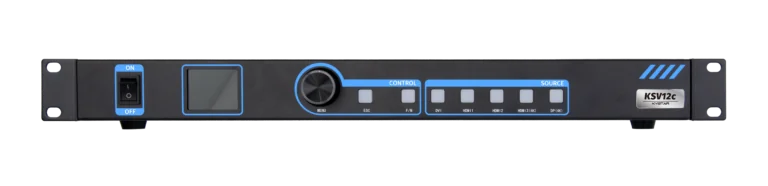
In professional LED display systems, the terms LED display processor and controller are often mentioned together, which can make it difficult for customers to understand their actual differences. Both devices play important roles in controlling visual output, but they handle different tasks within the signal workflow.
The LED display processor focuses on receiving, optimizing, and managing video signals, while the controller is responsible for transmitting processed data to LED panels and ensuring stable screen operation. Understanding how these two devices work differently helps users select the right equipment for stage productions, commercial displays, XR virtual production, and other advanced visual applications.
Understanding the Difference Between LED Display Processor and Controller
The main difference between an LED display processor and a controller is their position and responsibility in an LED control system. A processor works mainly on the video input side, where it manages content before it reaches the LED screen. A controller works closer to the display side, where it manages communication between the control system and LED modules.
An LED display processor is designed to improve the quality and flexibility of video content. It can process signals from different sources, adjust image parameters, manage screen layouts, and ensure that the output matches the requirements of the LED display. This makes it especially valuable for projects where multiple video sources or complex visual effects are required.
A controller, on the other hand, focuses on delivering image data accurately to the LED screen. It communicates with receiving cards, distributes data across LED cabinets, and ensures that every pixel displays the correct information. Without stable control and transmission, even high-quality video processing cannot achieve reliable visual performance.
In simple terms, the processor controls the appearance and organization of the content, while the controller controls how the LED display receives and presents that content.
How LED Display Processor and Controller Perform Different Functions ?
The functions of these two devices are closely connected, but their priorities are different. An LED display processor mainly handles image processing tasks before the signal reaches the display. For example, when a large stage production uses cameras, media servers, and playback systems at the same time, the processor helps combine these sources and create the required visual layout.
It can support functions such as signal switching, image scaling, resolution adjustment, multi-screen management, and visual optimization. These capabilities are important for applications that require real-time content changes and high-quality image output.
Compared with a processor, the controller focuses more on the technical communication between the system and the LED panels. It manages data transmission, screen mapping, and synchronization to make sure the processed image information reaches the correct position on the display.
For a large LED wall used in a concert or broadcast studio, the controller plays a critical role in maintaining stable operation. Since LED displays contain thousands or even millions of pixels, accurate data distribution is necessary to prevent problems such as image distortion, flickering, or inconsistent display performance.
LED Display Processor vs. Controller in Professional Applications
The difference between these two devices becomes clearer when looking at real-world applications. In a complex environment such as an XR virtual production studio, an LED display processor is responsible for handling multiple video signals, camera feeds, and virtual backgrounds. It helps create smooth and accurate visual content for filmmakers and production teams.
The controller works alongside the processor by delivering this processed information to the LED wall with precise timing. This cooperation allows the display to maintain low latency and stable image performance, which is essential for immersive production environments.
The same principle applies to concerts, exhibitions, corporate events, and commercial LED installations. A processor provides flexibility for managing creative content, while a controller ensures that the LED hardware performs consistently.
For simpler applications, some systems may not require advanced processing functions. However, when a project involves multiple inputs, large screen sizes, or demanding visual effects, the difference between processing and controlling becomes much more important.
Can an LED Display Processor Replace a Controller?
Many customers wonder whether an LED display processor can replace a controller or whether both devices are necessary. Traditionally, these two components have different responsibilities and are commonly used together in professional LED systems.
A processor cannot fully replace a controller because it does not perform the same data transmission functions. Likewise, a controller cannot replace a processor when advanced video management and image adjustment are required.
However, modern LED control technology has introduced integrated solutions that combine processing and controlling functions in a single device. These systems simplify installation, reduce equipment requirements, and make operation more convenient for users.
Kystar provides integrated LED control solutions that combine video processing and sending functions, helping customers build more efficient LED display systems for different applications. By combining multiple functions, these solutions can improve system flexibility while reducing the complexity of traditional setups.
How to Choose the Right Solution for an LED Display Project ?
Choosing between an LED display processor, controller, or an integrated solution depends on the specific requirements of the project.
For applications that involve multiple video sources, live switching, creative layouts, or advanced image management, a processor with strong processing capabilities is usually more suitable. This is common in stage performances, XR environments, broadcast studios, and large-scale events.
For projects that mainly require reliable communication between the control system and LED panels, a controller becomes the key component. It ensures that the screen operates smoothly and that every part of the display receives accurate data.
For users who want a simpler installation process while maintaining professional performance, an integrated processor and controller solution can provide a practical alternative. These systems are increasingly popular in commercial displays, rental LED screens, and customized visual projects because they combine convenience with functionality.
When selecting equipment, users should consider factors such as screen size, resolution, content complexity, operating environment, and future expansion needs. The right choice ensures that the LED display system can deliver stable and impressive visual results.
Conclusion
Although LED display processors and controllers are often used together, they serve different purposes in an LED control system. The processor focuses on video signal management, image optimization, and content flexibility, while the controller focuses on data transmission and stable LED screen operation.
Understanding the key differences between these two devices allows users to design more effective LED display solutions for various applications. As LED technology continues to develop, integrated control systems are providing new possibilities for easier installation and improved performance.
With professional experience in LED control technology, Kystar continues to support customers with solutions designed for stage productions, commercial displays, and advanced visual environments. By choosing the right combination of processing and control functions, businesses can achieve more reliable and engaging LED display experiences.
