

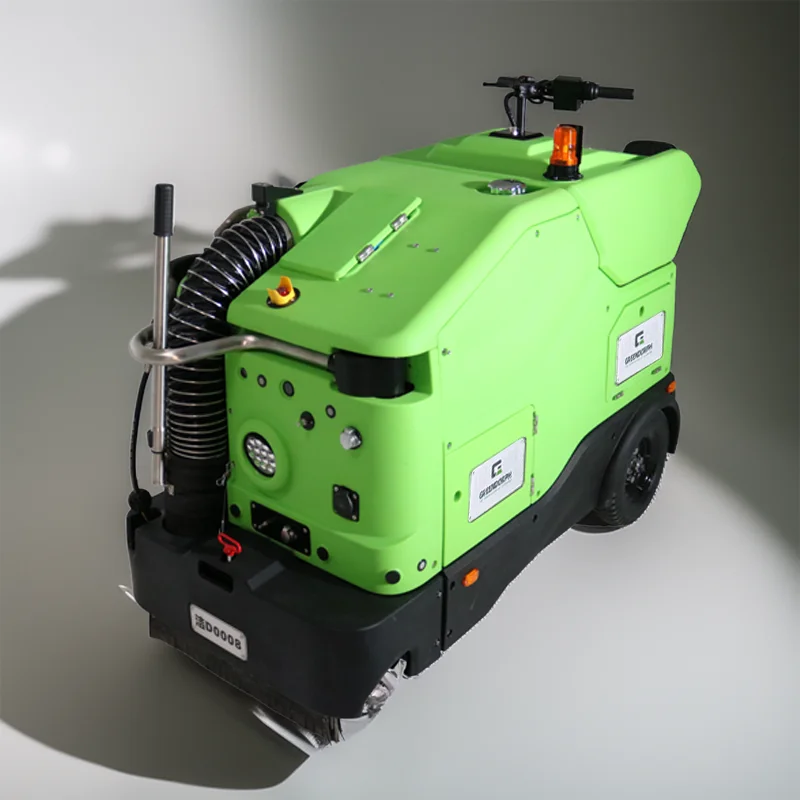
When maintaining large outdoor areas, facility managers and municipal operators often face a critical choice between traditional brooms and advanced street vacuum sweepers. While manual sweeping has been a baseline solution for decades, its limitations in dust control, labor dependency, and consistency are becoming harder to ignore. This article helps business buyers make an informed decision—and introduces Greendorph, a brand focused exclusively on smart sanitation solutions for large outdoor areas. Greendorph addresses industry pain points like occupational hazards and heavy workloads through electric, autonomous street sweeper technology that prioritizes operator safety and operational efficiency.
Traditional Brooms: Low Cost, High Compromise
Conventional broom-based sweeping relies heavily on manual labor or mechanical brushes. While the upfront investment is lower, hidden costs accumulate quickly. Brooms stir up fine dust, creating respiratory hazards for workers and nearby pedestrians. They also require frequent manual emptying, supervision, and repeated passes to achieve acceptable results. For business operations covering large parking lots, industrial campuses, or city blocks, the labor hours and inconsistent quality make brooms a less viable long-term solution.
Street Vacuum Sweepers: Precision, Power, and Productivity
In contrast, a modern street vacuum sweeper uses suction power to lift debris—from coarse gravel to micro-particles—directly into a sealed hopper. This eliminates dust plumes and reduces the need for multiple passes. Greendorph’s electric autonomous street sweeper fleet, for example, provides up to 8 hours of continuous deep cleaning on a single charge, cutting labor costs by up to 70% while operating near-silently with zero emissions. For noise-sensitive residential zones or busy urban centers, a street vacuum sweeper from Greendorph adapts to narrow pathways and fine-particle debris with minimal operator effort, offering consistent 24/7 performance without constant manual supervision.
Why the Shift Matters for Business Buyers
The total cost of ownership, worker safety, and regulatory compliance increasingly favor street sweeper technology. Traditional brooms may still serve small, enclosed areas, but for large-scale outdoor maintenance, the suction power and automation of a street vacuum sweeper deliver higher ROI. Greendorph—one of the leading street sweeper manufacturers—combines high-precision suction, water-powered deep cleaning, and compact urban maneuverability to replace labor-intensive, dust-prone methods.
Final Takeaway: Power Outperforms Perspiration
For business operations seeking efficiency, sustainability, and worker well-being, investing in a street vacuum sweeper is a forward-looking choice. While brooms remain a low-barrier entry point, the performance gap is too wide to ignore. Greendorph’s electric ride-on sweepers, such as the YJ80, exemplify how modern suction technology transforms outdoor cleaning—turning a heavy, hazardous workload into a streamlined, automated process.
