

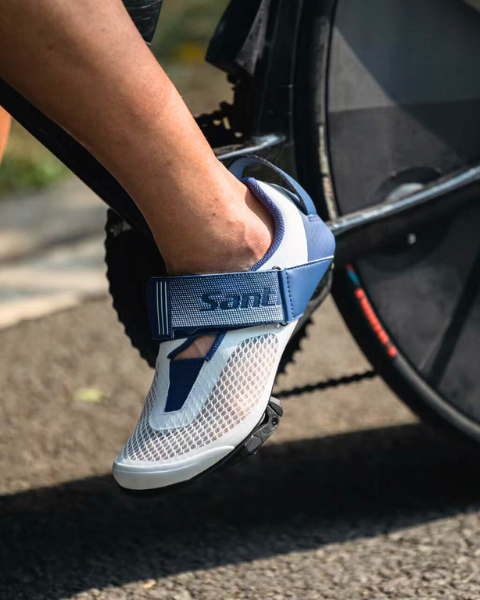
Triathlon footwear has to manage several demands at once: the shoe may be entered quickly after the swim, remain exposed to moisture, hold the foot securely during the bike leg, and avoid adding unnecessary complexity to the transition.
In triathlon footwear, ventilation also controls how quickly water and heat can leave the shoe. Open mesh, sole vents, quick-dry linings, and wide entry structures help remove water and heat, but every opening and closure also becomes part of the external shape of the shoe.
No aerodynamic coefficient or drag figure is specified for these triathlon designs, so the relationship between airflow and aerodynamics is better treated as a design balance than as a quantified claim. The engineering balance centers on releasing water and heat while keeping the shoe compact, stable, and quick to operate during racing.
Ventilation Begins with Water and Heat Management
A triathlon shoe reaches the bike in a different condition from a conventional road shoe. Moisture from the swim, warm race conditions, and limited transition time make airflow and evaporation central to the design. The NF model uses a large 3D air-mesh upper and a ventilated outsole so air can move through the shoe and water can escape.
The cycling shoe size guide remains relevant because a highly ventilated upper still has to fit a measured foot; length and width are considered together and compared with the measurements provided in the size chart. A loose fit would undermine retention, while excessive compression could make wet-foot discomfort worse. The same dimensional checks also matter in flat pedal bike shoes, although their pedal interface and ventilation priorities differ.
Flat-Pedal Ventilation Serves Another Interface
The comparison with flat pedal bike shoes shows how purpose changes ventilation priorities. A flat-pedal model uses no cleat and relies on a broad rubber contact area for control and walking practicality, so its outsole architecture is built around pedal grip rather than rapid water release after a swim.
Triathlon construction instead has to combine moisture management with a cleated pedaling platform and fast entry. That is why mesh area, sole openings, lining behavior, and closure access become part of the same transition-focused system rather than independent comfort features. A cycling shoe size guide still provides the dimensional baseline before those category-specific outsole differences are evaluated.
Aerodynamic Restraint Favors Simple, Controlled Surfaces
Aerodynamic design does not mean closing every vent. It means managing the shoe’s external structures without compromising the functions that the race requires. Santic’s LiXing model uses bionic shark-gill mesh to accelerate airflow and moisture evaporation, strategically placed sole vents, a quick-access pull tab, quick-dry lining, and a full-carbon outsole with stiffness index 12.
Those ventilation and transition features are not accompanied by a measured drag reduction, so no numerical aerodynamic advantage can be inferred. The cycling shoe size guide still matters at this stage because a stable fit keeps the upper and closure working in the position for which they were designed rather than allowing unnecessary movement around the foot. By contrast, flat pedal bike shoes place the external contact problem mainly in rubber and platform geometry.
Transition Hardware Must Stay Controlled
That design logic differs from flat pedal bike shoes, where broad rubber contact and freedom from cleat engagement dominate the pedal interface. Triathlon models typically organize the upper around a quicker entry sequence and a cleated platform. NF uses a wide opening and quick-entry hook-and-loop strap, while LiXing adds a heel pull tab and race-oriented carbon structure.
Fewer complicated steps during T1 can be useful without requiring the claim that a particular closure is aerodynamically superior. The balance is practical: ventilation must be generous enough to release heat and moisture, while the external hardware and upper shape remain controlled and compatible with secure pedaling. A cycling shoe size guide cannot resolve transition handling by itself, but it can prevent excess internal movement from complicating closure and upper control.
Transition Speed, Sole Stiffness, and Fit Have to Agree
Different stiffness and ventilation targets appear across Santic’s NF and LiXing triathlon designs. NF uses a TPU + mesh upper and nylon + fiberglass outsole. It is listed with a regular last, compact toe box, three-star instep adjustability, five-star breathability, stiffness index 6, a 280 g single-shoe weight at size 42, and Triathlon Training use.
LiXing moves toward a more rigid race platform with a stiffness-12 full-carbon outsole and compatibility with 3-bolt road cleat systems, including SPD-SL and LOOK-compatible setups. In both cases, the cycling shoe size guide connects foot dimensions to the chosen model so that rapid entry does not come at the cost of uncontrolled foot movement.
Walkability alone does not make flat pedal bike shoes suitable for the transition demands of triathlon. Their cleat-free design and grippy rubber prioritize platform-pedal control, whereas a triathlon shoe must allow the rider to enter quickly, secure the foot, engage a road-style cleat system, manage moisture, and sustain the bike leg.
Aerodynamics sits within that package rather than above it. Without a measured drag figure, the defensible conclusion is that a compact, secure, efficiently ventilated construction avoids obvious functional conflicts while the shoe’s stated functions remain transition access, breathability, moisture release, and sole performance.
Balancing ventilation and aerodynamics in triathlon shoes is less about maximizing one variable than about preventing the variables from working against one another. Large mesh zones and outsole vents can manage water and heat; quick-entry straps, pull tabs, and quick-dry linings reduce transition friction; carbon or composite soles supply the required pedaling platform; and measured length and width keep the foot stable inside that structure.
Santic’s NF and LiXing models demonstrate two different balances of breathability, stiffness, and transition access. Because no drag coefficient is specified, their aerodynamic role should not be overstated. The technically sound reading is that triathlon footwear must stay ventilated, compact, secure, and quick to operate at the same time.
