

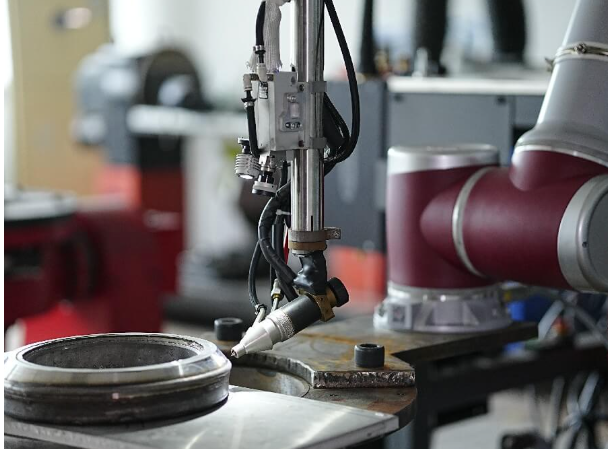
In the competitive manufacturing landscape of 2026, the demand for precision, speed, and high-mix production has never been greater. For facilities utilizing an industrial welding robot, the primary objective is to maximize “arc-on” time—the actual minutes spent joining metal. However, traditional programming methods often create a significant bottleneck. This is where the integration of Offline Programming (OLP) becomes a game-changer for the modern collaborative welding robot.
By shifting the programming process from the physical shop floor to a digital environment, manufacturers can eliminate downtime, drastically reduce errors, and unlock the full potential of high-performance hardware like the JAKA Zu 30. This article explores the strategic role OLP plays in refining welding operations and why it is the essential partner for collaborative automation.
1. Eliminating Production Downtime
The most immediate benefit of offline programming is the decoupling of programming from production. In a traditional “online” setup, an industrial welding robot must be stopped and taken out of service so that a technician can use a teach pendant to manually record points. This “non-productive” time can lead to days of lost revenue, especially for complex parts or large-scale assemblies.
With OLP, a digital twin of the collaborative welding robot and the entire workcell is created in a virtual environment. While the physical robot is busy finishing a current batch of parts, an engineer can be in the office designing, simulating, and validating the welding paths for the next project. Once the program is finalized, it is simply uploaded to the robot, reducing transition time from days to a mere fraction of an hour.
2. Optimizing Complex Weld Paths
Welding often involves intricate geometries, tight corners, and difficult-to-reach joints. In a physical environment, a programmer might need several trial-and-error attempts to ensure the welding torch doesn’t collide with the workpiece or the fixture.
Offline programming software allows for comprehensive collision detection and reachability analysis in a 100% safe virtual setting. The software can calculate the most efficient trajectory, minimizing “air moves” (movements where the robot is moving but not welding). By optimizing these paths digitally, manufacturers can reduce the cycle time per part, directly increasing the overall equipment effectiveness (OEE) of their industrial welding robot fleet.
3. Mastering High-Mix, Low-Volume Agility
The modern marketplace is moving toward extreme customization. For job shops handling small batches, the time spent programming often exceeds the time spent welding. This is the “high-mix, low-volume” (HMLV) challenge that has historically made automation difficult for smaller firms.
OLP makes HMLV production profitable. By using “CAD-to-Path” features, the software can automatically generate weld trajectories directly from the 3D model of the part. This automated approach is up to 10 times faster than manual teaching. It allows a collaborative welding robot to switch between completely different tasks—such as moving from a thin-gauge aluminum bracket to a heavy steel frame—seamlessly, ensuring that even a batch of one or two parts can be automated economically.
4. Enhanced Safety and Precision
While collaborative robots are designed to work safely alongside humans, the process of teaching a welding path manually involves being in close proximity to a heavy arm and a sharp, potentially hot torch. Offline programming moves this work into a comfortable office environment, reducing the risk of workplace accidents.
Furthermore, OLP allows for precise control over welding parameters—such as voltage, wire feed speed, and travel angle—that can be difficult to fine-tune using a handheld pendant. This level of digital precision ensures that the “first part” produced is a “good part,” significantly reducing scrap and rework costs.
5. Power and Precision: The JAKA Zu 30 in Welding
To truly benefit from offline programming, you need a robot that can translate digital commands into physical perfection. The JAKA Zu 30 is the ideal platform for heavy-duty collaborative welding. Building on the hallmark ease of the JAKA Zu series, the Zu 30 offers the ruggedness and reach required for industrial-scale fabrication that was previously reserved for caged industrial bots.
Why the JAKA Zu 30 is the Perfect Welding Partner:
Massive 30 kg Payload: Welding torches, high-torque wire feeders, and specialized sensors add up quickly. The Zu 30’s high payload capacity allows it to carry advanced welding equipment without compromising speed or safety.
Extended 1350 mm Reach: Large workpieces like automotive frames or structural beams require a wide working radius. The Zu 30 covers more ground, reducing the need for expensive external linear tracks or repositioning the robot frequently.
IP65 Durability: Welding is a dirty, spark-filled job. The Zu 30 is built with high ingress protection (IP65), ensuring it can thrive in harsh environments where dust and metal particulates are common.
Sub-Millimeter Repeatability: With a repeatability of ±0.05 mm, the Zu 30 ensures that every weld bead is laid down with surgical precision, matching the exact paths designed in your OLP software.
Seamless Syncing: The Zu 30 supports multiple protocols like Profinet and Modbus TCP, making it easy to sync the robot with both domestic and global welding power sources and offline simulation packages.
Conclusion: The Future of Frictionless Fabrication
In 2026, the most efficient factories are those that bridge the gap between digital design and physical execution. Offline programming is the bridge that turns a collaborative welding robot from a simple tool into a highly optimized production engine. By pairing advanced simulation software with the high-payload, high-precision capabilities of the JAKA Zu 30, manufacturers can achieve a level of agility and quality that was previously impossible.
When you remove the constraints of traditional programming, your industrial welding robot is no longer a static machine—it becomes a dynamic asset ready to tackle any challenge your design team can imagine.
